The New Stage Direction: Blocking for Confidence
Hybrid shows require stage direction that serves both the room and the camera, and blocking makes dual-audience storytelling feel effortless.
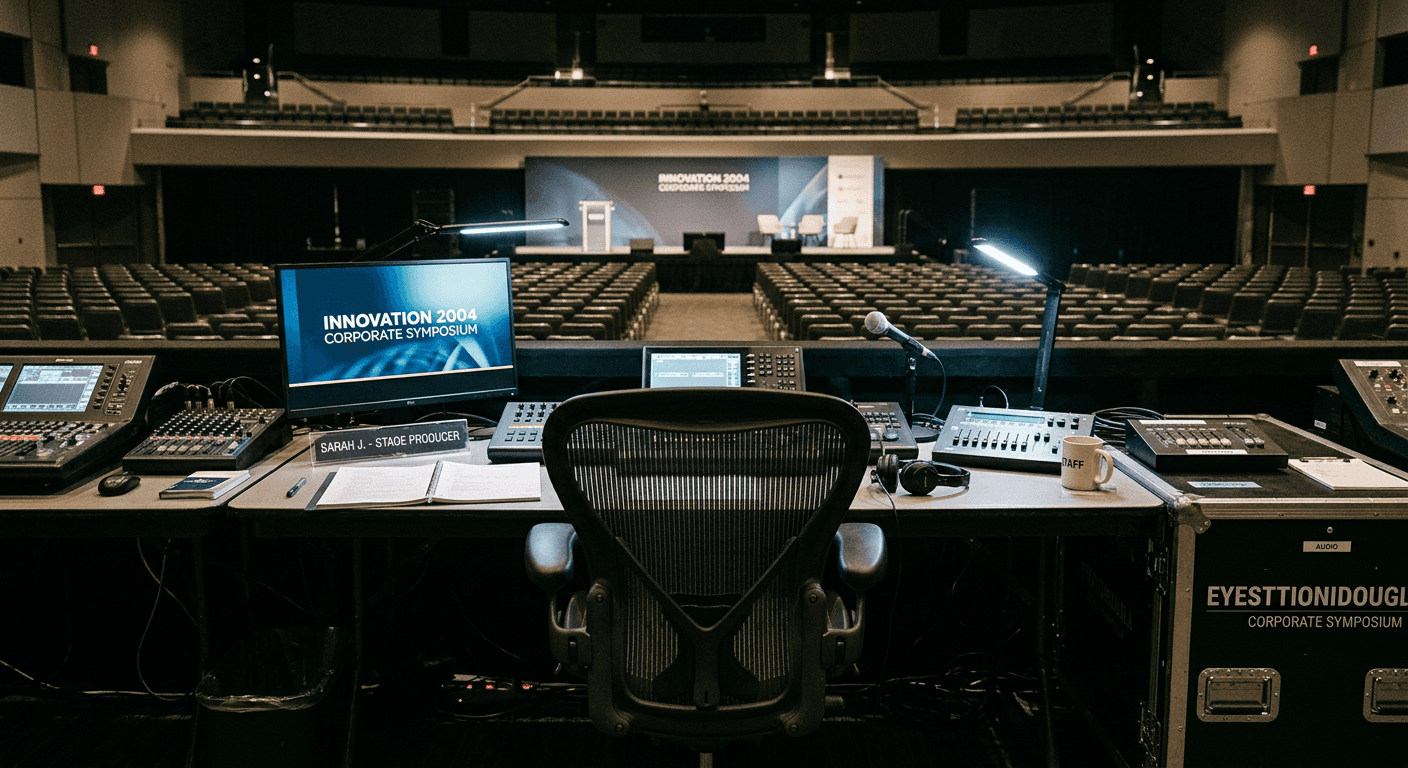
Hybrid shows changed the job description for stage direction. It used to be enough to “cover the room”: sightlines, stage marks, confidence monitors, clean handoffs. Now you’re also staging for a second audience—the camera—without making the first audience feel like they’re watching a TV taping.
Blocking is the bridge. Done well, it doesn’t feel like choreography. It feels like ease: the speaker looks grounded, the story lands cleanly, the broadcast reads intentional, and nobody’s distracted by awkward wandering or weird dead space.
Hybrid truth #1: The camera punishes ambiguity
In-room, a little drift can feel natural. On camera, it looks like uncertainty. A presenter who paces while making a key point often reads as nervous—even if they’re not. Blocking gives the speaker a repeatable physical plan so their energy goes into the message, not the “where do I go now?” math.
A good hybrid block answers three questions at all times:
Where should the speaker be for this beat?
Where should they look?
What’s the cleanest transition to the next moment?
Hybrid truth #2: Confidence is often physical, not verbal
We spend a lot of time polishing words. But in high-stakes keynotes, “confidence” is usually the byproduct of predictable mechanics:
The presenter knows where their marks are.
The screens support them instead of competing with them.
The camera cues aren’t surprises.
The transitions are rehearsed like muscle memory.
When those conditions are true, speakers stop performing “stage presence” and start communicating.
A practical blocking framework (that doesn’t feel robotic)
Assign each segment a home base
Think of the stage in zones, not inches. Most hybrid stages can be simplified into three functional areas:
Center (Authority Zone): business priorities, big announcements, moments that need weightLeft/Right
(Support Zones): demos, guest intros, conversational beats, lighter transitions
Downstage (Connection Zone): direct address, emotional moments, calls-to-action
Center (Authority Zone): business priorities, big announcements, moments that need weight
Give each segment a default home base and you eliminate 80% of purposeless movement. The speaker learns: “When I’m making this kind of point, I’m here.”
Move only when the story turns
Movement should signal a change—topic, tone, speaker, or format. If nothing is changing, the speaker stays put. A simple rule that works: one move per beat (not per sentence, not per slide). And that move should be motivated, like:
“We’re shifting from context → proof.”
“We’re going from solo → conversation.”
“We’re handing off to a demo.”
Build camera-friendly stillness into the script
Stillness is underrated. A clean, planted moment lets the camera settle and the audience absorb. Bake in two kinds of stillness:
Landing stillness: after a key line, hold for a half-beat before advancing
Listening stillness: during a guest intro, Q&A, or demo moment—don’t fidget, don’t narrate over it
This is where hybrid often wins or loses polish. The room forgives it. The camera never does.
Treat eyeline as a production decision
Hybrid shows create an eyeline triangle: live audience, main camera, confidence monitor/teleprompter.
If the speaker’s eyes constantly bounce, the broadcast reads scattered. The fix isn’t “look at the camera more.” The fix is deciding—per moment—what “connection” means. A clean approach:
Camera moments: direct-to-camera lines, welcome/close, sensitive updates, single-sentence emphasis
Room moments: humor, applause lines, in-person engagement, Q&A with visible audience
Monitor moments: only when needed; design monitors so they support, not hijack, the face
Then rehearse those choices so the presenter isn’t negotiating eyeline live.
Choreograph the handoffs (not just the content)
Hybrid handoffs are where energy leaks: “Now I’d like to bring up…” while the guest appears, the camera searches, the speaker stands in no-man’s land. Instead, block handoffs like mini-scenes:
Where does the outgoing speaker end?
Where does the incoming speaker enter?
Who owns the stage during the applause?
What does the outgoing speaker do with their body once they’re “done”?
When you plan this, the show feels more like a story and less like a meeting.
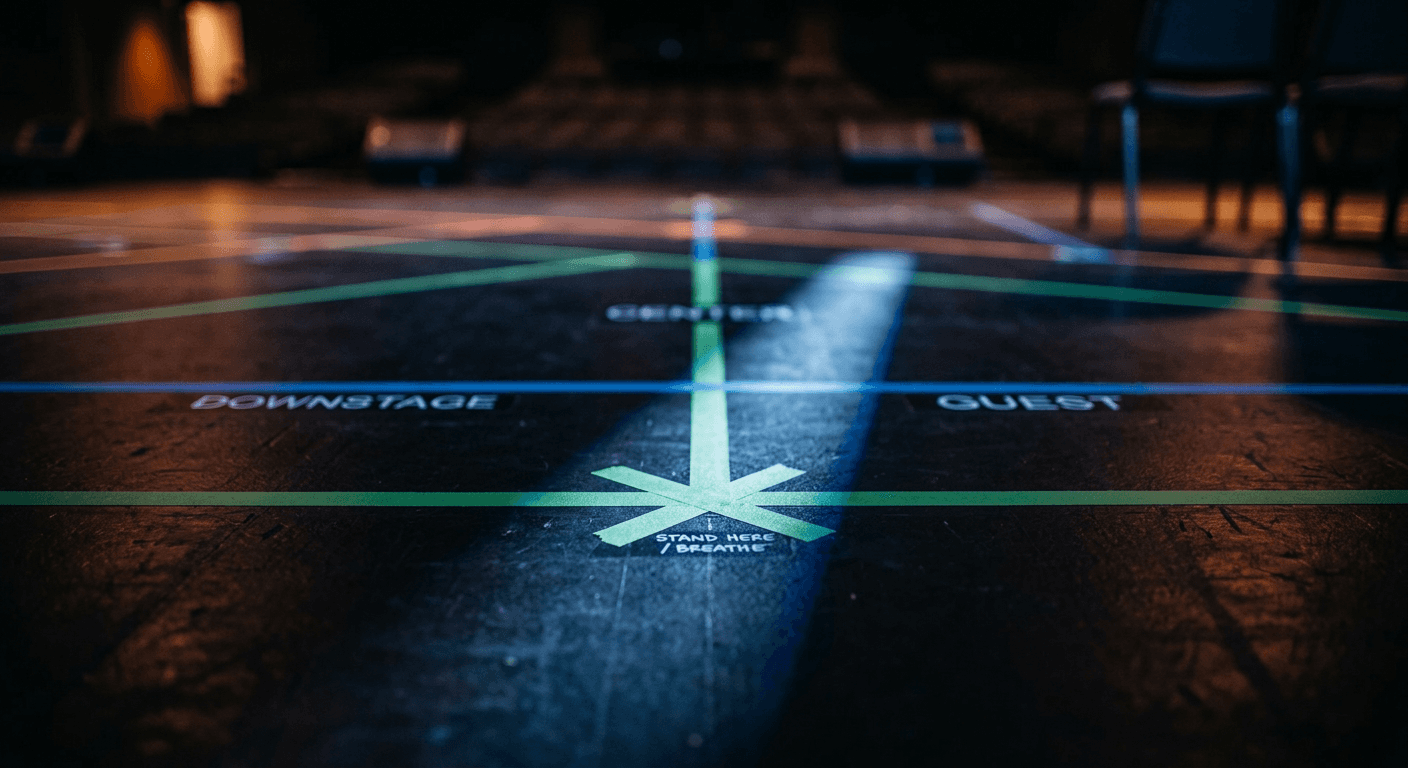
The rehearsal move that changes everything.
Instead of only using spike marks for exact positions, tape “zones” with labels: CENTER / DEMO / GUEST / DOWNSTAGE. It gives speakers a mental map, not a precision test. You can adjust camera framing and scenic realities without re-teaching the whole stage every time something shifts.
If you’re pressed for time, rehearse the first 90 seconds and every transition. You can survive rough edges in the middle. You can’t survive a wobbly open or a messy handoff.
What good blocking looks like (from the audience’s perspective)
They shouldn’t notice it. They should just feel that:
the speaker is present,
the screens are helping,
the camera is “where it’s supposed to be,”
and the whole thing has momentum.
That’s the new stage direction: less choreography for choreography’s sake, more physical clarity in service of the story.
Good blocking disappears. It turns a hybrid stage into a readable space: the speaker looks sure-footed, the camera knows what it’s hunting, and the audience—both in the room and on stream—stays with the story. The goal isn’t choreography. It’s clarity.
Onward.
About
Field notes
Ideas, observations, and occasional opinions on design, craft, culture, and everything in between.